Source page 1
Mary Webb
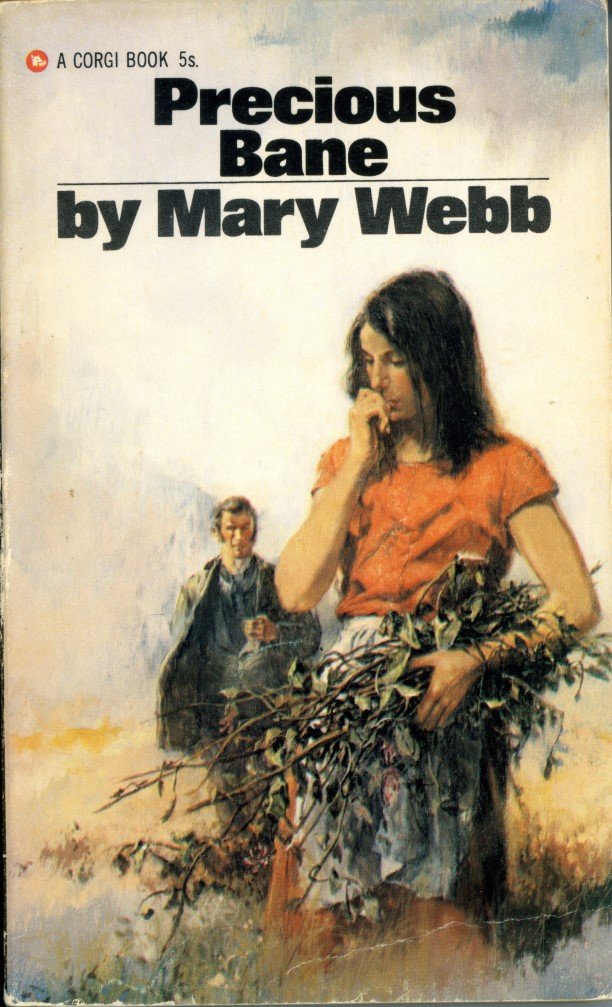
Precious Bane
An Introduction by Rt Hon. Stanley Balwin P.M.
INTRODUCTION
Mary Meredith, the author of Precious Bane, was born in the little village of Leighton,
near Cressage, under the Wrekin, on March 25th, 1881, and died at St. Leonards, October
8th, 1927, and was buried at Shrewsbury. She was the daughter of George Edward Mere-
dith, a school-master of Welsh descent, by his marriage with Sarah Alice Scott, daughter of
an Edinburgh doctor of the clan of Sir Walter Scott. She was the eldest of six children and
spent her early girlhood at The Grange, a small country house near Much Wenlock; from
12 to 21 she lived at Stanton-on-Hine- Heath, six miles north-east of Shrewsbury, and for
the next ten years at The Old Mill, Meole Brace, a mile from Shrews-bury. In 1912 Mary
Meredith married Mr. Henry Bertram Law Webb, a Cambridge graduate and a native of
Shrop-shire. After two years at Weston-super-Mare, where Mr. Webb had a post in a
school, Mr. and Mrs. Webb returned to Shropshire, living at Pontesbury and Lyth Hill,
working as market gardeners and selling the produce at their own stall in Shrewsbury mar-
ket. Mrs. Webb had written stories and poems from childhood, but it was at this period
that she seriously turned her mind to writing novels. A volume of essays on nature, The
Spring of Joy, and three novels, The Golden Arrow, Gone to Earth , and The House in
Dormer Forest, had been published before she came to live in Lon-don in 1921. Seven for
a Secret followed in 1922, and Precious Bane in 1924. It was awarded the ‘Femina Vie
Heureuse’ Prize for 1924-5, given annually for the best work of imagination in prose or
verse descriptive of English life by an author who had not attained sufficient recognition.
I am indebted for these biographical particulars to Mr. Webb, to whom Precious Bane is
inscribed. I never met Mary Webb and knew nothing of her work until I read Precious
Bane at Christmas, 1926. I am glad to think that I was in time to send her a few words of
Source page 2
appreciation.
The stupid urban view of the countryside as dull receives a fresh and crushing answer in
the books of Mary Webb. All the novels except Precious Bane are set in the hill country of
south-west Shropshire, between the Clee Hills and the
Breiddens, and between Shrewsbury and Ludlow. The scene of Precious Bane is the coun-
try of north Shropshire meres —the Ellesmere district, but the dialect is that of south
Shrop-shire. It is the country of the Severn lowlands and of isolated upland ridges where
Celt and Saxon have met and mingled for centuries. For the passing traveller it is inhabited
by an uncommunicative population dwelling among places with names like Stedment and
Squilver and Stiperstone, Nipstone and Nind. There are of course the old castles and tim-
bered black and white houses for the motoring visitors. But to the imaginative child
brought up among the ploughlands and pools and dragon-flies there is ‘a richness on the
world, so it looked what our parson used to call sumptuous.’ It is this richness which Mary
Webb saw and felt as a girl and remembered with lyrical intensity as a woman.
She has interlaced with this natural beauty the tragic drama of a youth whose whole be-
ing is bent on toil and thrift and worldly success only to find himself defeated on the mor-
row of the harvest by the firing of the comricks by the father of his lover. The dour figure
of Gideon Sarn is set against that of his gentle sister, Prudence, who tells the tale. She is a
woman flawed with a hare-shotten lip and cursed in the eyes of the neighbours until her
soul’s loveliness is discerned by Kester Woodseaves, the weaver. And so there comes to
her at the end of the story the love which is ‘the peace to which all hearts do strive.’
The strength of the book is not in its insight into human character, though that is not lack-
ing. Nor does it lie in the inevitability with which the drama is unfolded and the sin of an
all-absorbing and selfish ambition punished. It lies in the fusion of the elements of nature
and man, as observed in this remote countryside by a woman even more alive to the
changing moods of nature than of man. Almost any page at random will furnish an illustra-
tion of the blending of human passion with the fields and skies.
Source page 3
‘So they rode away, and the sound of the people died till it was less than the hum of a
midge, and there was nothing but a scent of rosemary, and warm sun, and the horse
lengthen-ing its stride towards the mountains, whence came the air of morning’ (p. 126).
One reviewer compared Precious Bane to a sampler stitched through long summer eve-
nings in the bay window of a remote farmhouse. And sometimes writers of Welsh and
Border origin, like William Morris, have had their work compared to old tapestries. But
while these comparisons suggest something of the harmonies of colour they fail to convey
the emotional force which glows in these pages. Nature to Mary Webb was not a pattern
on a screen. Her sensibility is so acute and her power over words so sure and swift that
one who reads some passages in Whitehall has almost the physical sense of being in
Shropshire corn-fields.
Precious Bane is a revelation not unearthly but of earthly beauty in one bit of the Eng-
land of Waterloo, the Western edge, haunted with the shadows of superstition, the legend
-ary lore and phantasy of neighbours on the Border, differing in blood and tongue. This
mingling of people and tradi-tions and turns of speech and proverbial wisdom is what
Mary Webb saw with the eye of the mind as she stood at her stall in Shrewsbury market,
fastened in her memory, and fashioned for us in the little parcel of novels which is her leg-
acy to literature
STANLEY BALDWIN
10 Downing Street, S.W.l
October 1928