Source page 1
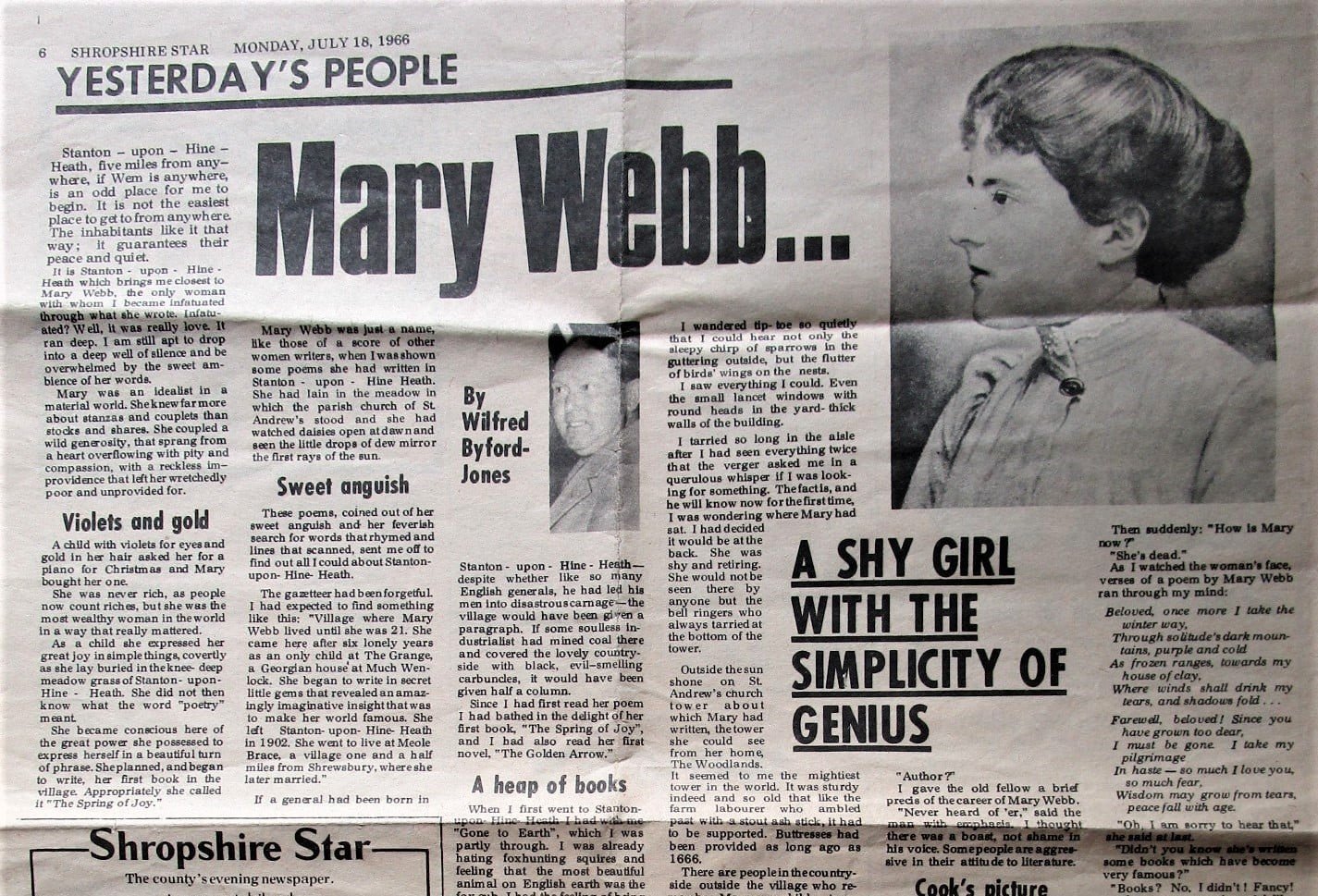
Read text detected in this scan
Automatic transcription may contain errors or an incorrect reading order.
6 SHROPSHIRESTAR MONDAY, JULY 18, 1966
YESTERDAY’S PEOPLE |
Stanton — upon - Hine — Heath, five miles from any— here, if Wem is anywhere, ‘an odd place for me to begin. It is not the easiest
place to get to from anywhere.
The inhabitants like it that way; it guarantees their peace and quiet. It is Stanton - upon - Hine - brings me closest to nly woman
ran deep. I am still ap di into a deep well of silence and be overwhelmed by the sweet ambience of her words.
Mary was an idealist in a material world. Sheknew farmore about stanzas and couplets than stocks and shares. She coupled a wild generosity, that sprang from a heart overflowing with pity and compassion, with a reckless im— providence that lefther wretchedly poor and unprovided for.
Violets and gold
A child with violets for eyesand gold in her hair asked her for a piano for Christmas and Mary bought her one.
She was never rich, as people now count riches, but she was the most wealthy woman in the world in a way that really mattered.
As a child she expressed her great joy in simple things, covertly as she lay buried intheknee- deep meadow grassof Stanton- upon- Hine - Heath. She did not then know what the word “poetry” meant
She became conscious here of the great power she possessed to express herself in a beautiful turn ‘of phrase. Sheplanned, and began her first book in the y she called
it "The Spring of Joy
women writers, when Iwasshown
some poems she had written In Stanton - upon - Hine Heath. She had lain in the meadow in which the parish church of St Andrew's stood and she had watched daisies open atdawnand seen the little drops of dew mirror the firet rays of the sun.
Sweet anguish
‘These poems, coined out of her sweet anguish and her feverish search for words thatrhymed and lines that scanned, sent me off to find out all [could about Stantonupon- Hine- Heath,
‘The gazetteer had beenforgetful. I had expected to find something like this: "Village where Mary Webb lived until she was 21. She came here after six lonely years as an only child at The Grange, & Georgian house at Much Wenlock. She began to write in secret little gems that revealed an amazingly imaginative insightthatwas to make her world famous. She Idt Stanton- upon- Hine- Heath in 1902. She went to live at Meole Brace, a village one and a half miles from Shrewsbury, whereshe later married.”
If @ general had been born in
Shropshire aoe
‘The county’s evening newspaper.
Mary Webb.
Stanton- upon- Hine - Heath— despite whether like so many English generals, he had led his men into disastrouscarnage—the village would have been given a paragraph. If some soulless industrialist had mined coal there and covered the lovely co' side with black, evil-smelling carbuncles, it would have been given half a column. - Since | had first read her poem I had bathed in the delight of her first book, "The Spring of Joy”, and I had also read her first novel, "The Golden Arrow.” 5
A heap of hooks
ent to Stanton-
yhen I first
wal ating foxhunting squires and feeling that the most beautiful
animal on English earth was the
had ak ot 2 hae
that I could hear not only the
sleepy chirp of sparrows in the ‘outside, but the flutter ‘of birds’ wings on the nests,
I saw everything I could. Even the small lancet windows with round heads in the yard- thick walls of the building.
he will know now for thefirsttime, T was wondering where Mary had
WITH THE SIMPLICITY OF GENIUS
She would notbe “Author?”
seen there by one but the ringers who
I gave the old fellow a brief
precis of thecareer of Mary Webb.
"Never he: of “er,” said the
always tarried at the bottom of the tower.
Outside thesun shone on St. Andrew’s church tower about which Mary had written, thetower she could see from her home, The Woodlands. It seemed to me the mightiest tower in the world. Itwas sturdy
and so old that like the labourer who ambled
There eepepicin tite ude ‘ouge be wage who Fe
Source page 2
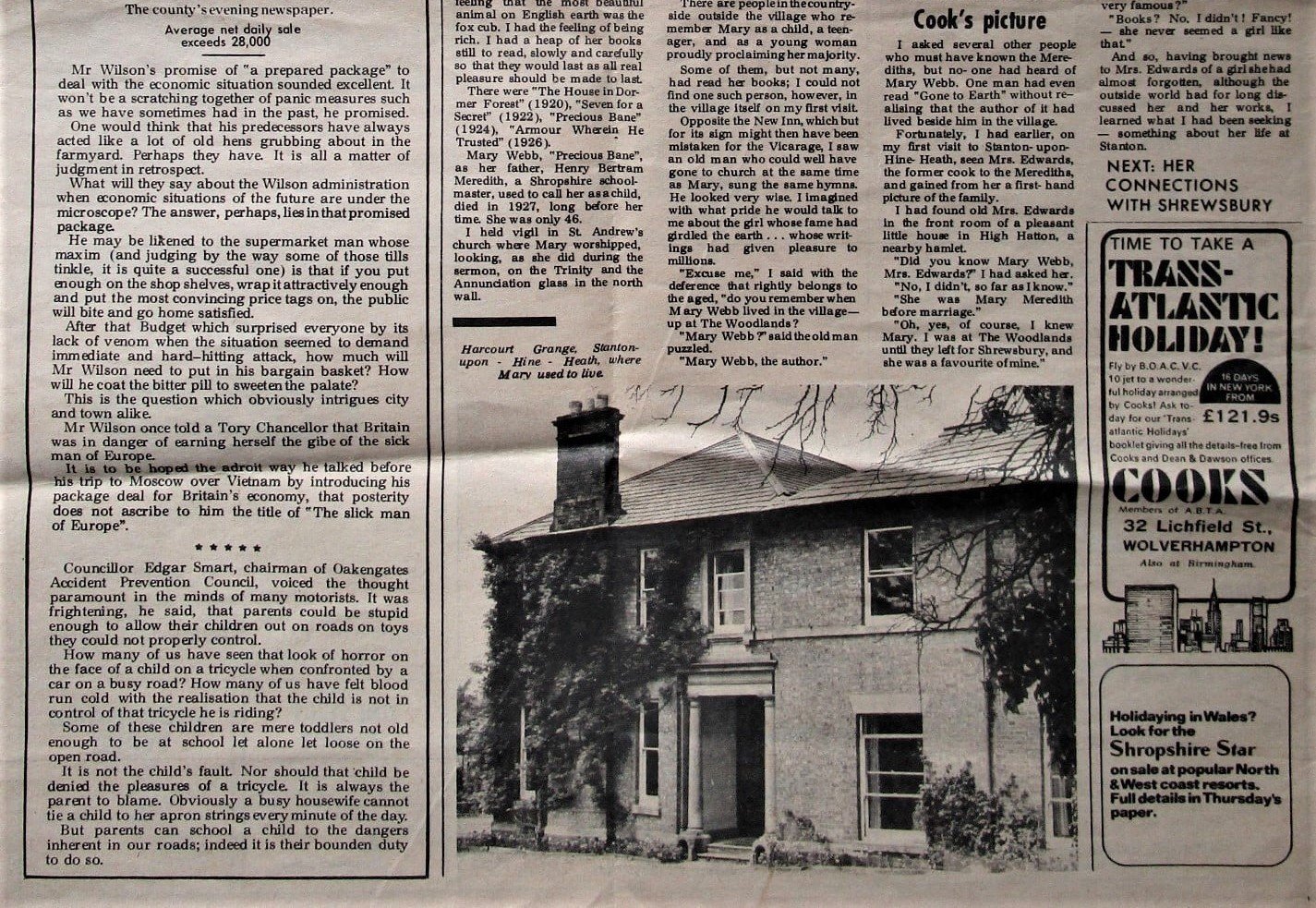
Read text detected in this scan
Automatic transcription may contain errors or an incorrect reading order.
‘The county’s evening newspaper.
Average net daily sole exceeds 28,000
Mr Wilson’s promise of “a prepared package” to deal with the economic situation sounded excellent. It won't bea scratching together of panic measures such as we have sometimes had in the past, he promised.
One would think that his predecessors have always acted like a lot of old hens grubbing about in the farmyard. Perhaps they have. It is all a matter of judgment in retrospect.
What will they say about the Wilson administration when economic situations of the future are under the microscope? The answer, perhaps, lies in that promised package.
He may be likened to the supermarket man whose maxim (and judging by the way some of those tills tinkle, it is quite a successful one) is that if you put enough on the shop shelves, wrapitattractively enough and put the most convincing price tags on, the public will bite and go home satisfied.
After that Budget which surprised everyone by its lack of venom when the situation seemed to demand immediate and hard-hitting attack, how much will Mr Wilson need to put in his bargain basket? How will he coat the bitter pill to sweeten the palate?
This is the question which obviously intrigues city and town alike.
Mr Wilson once told a Tory Chancellor that Britain was in danger of earning herself the gibe of the sick
to, y aes fo Moscow over Vietnam by introducing his
package deal for Britain’s economy, that posterity does not ascribe to him the title of “The slick man of Europe”.
eee ak
Councillor Edgar Smart, chairman of Oakengates Accident Prevention Council, voiced the thought paramount in the minds of many motorists. It was frightening, he said, that parents could be stupid enough to allow their children out on roads on toys they could not properly control.
How many of us have seen that look of horror on the face of a child on a tricycle when confronted by a car on a busy road? How many of us have felt blood run cold with the realisation that the child is not in control of that tricycle he is riding?
Some of these children are mere toddlers not old enough to be at school let alone let loose on the open road.
It is not the child’s fault. Nor should that ‘child be denied the pleasures of a tricycle It is always the parent to blame. Obviously a busy housewife cannot tie a child to her apron strings every minute of the day.
But parents can school a child to the dangers inherent in our roads; indeed it is their bounden duty to do so.
leeung Wat-me most peaunm animal on English earth was the fox cub. I had the feeling of being rich, I had a heap of her books still to read, slowly and carefully so that they would last as all real pleasure should be made to last.
There were “The House in Dormer Forest” (1920), “Seven fora Secret” (1922), "Precious Bane” (1924), “Armour Wherein He Trusted” (1926). 3
Mary Webb, “Precious Bane”, as her father, Henry Bertram Meredith, a Shropshire schoolmaster, used to call her asachild, died in 1927, long before her time. She was only 46,
I held vigil in St Andrew's church where Mary worshipped, looking, as she did during the sermon, on the Trinity and the Annundation glass in the north wall.
Harcourt Grange, _Stantonupon - Hine - Heath, where
Mary used to live ¢
‘There are peopiein thecountryside outside the village who re member Mary asa child, a teenager, and as a young woman proudly proclaiming her majority.
Some of them, but not many, had read her books; I could not find one such person, however, in the village itself on my first visit.
Opposite the New Inn, which but for its sign might then have been mistaken for the Vicarage, I saw an old man who could well have gone to church at the same time as Mary, sung the same hymns. He looked very wise. I imagined with what pride he would talk to me about the girl whose fame had girdled the earth... whose writings had given pleasure to millions.
"Excuse me,” I said with the deference that rightly belongs to the aged, "do you remember when Mary Webb lived in the village— up at The Woodlands?
“Mary Webb?’ saidtheoldman
puzzled. “Mary Webb, the author.”
Cook’s picture
I asked several other people who must have known the Merediths, but no- one had heard of Mary Webb. One man had even read "Gone to Earth” without re— alising that the author of it had
Fortunately, I had earlier, on my first visit to Stanton- upon- Hine Heath, seea Mrs. Edwards, the former cook to the Meredith, and gained from her a first- hand picture of the family.
I had found old Mrs. Edwards in the front room of a pleasant little house in High Hatton, a nearby hamlet.
"Did you know Mary Webb, Mrs. Edwards?" I had asked hi
"No, I didn’t, so far as I know.’
"She was Mary Meredith before marriage.”
"Oh, yes, of course, I knew Mary. I was at The Woodlands until they left for Shrewsbury, and she was a favourite ofmine.”
NEXT: HER CONNECTIONS WITH SHREWSBURY