Source page 1
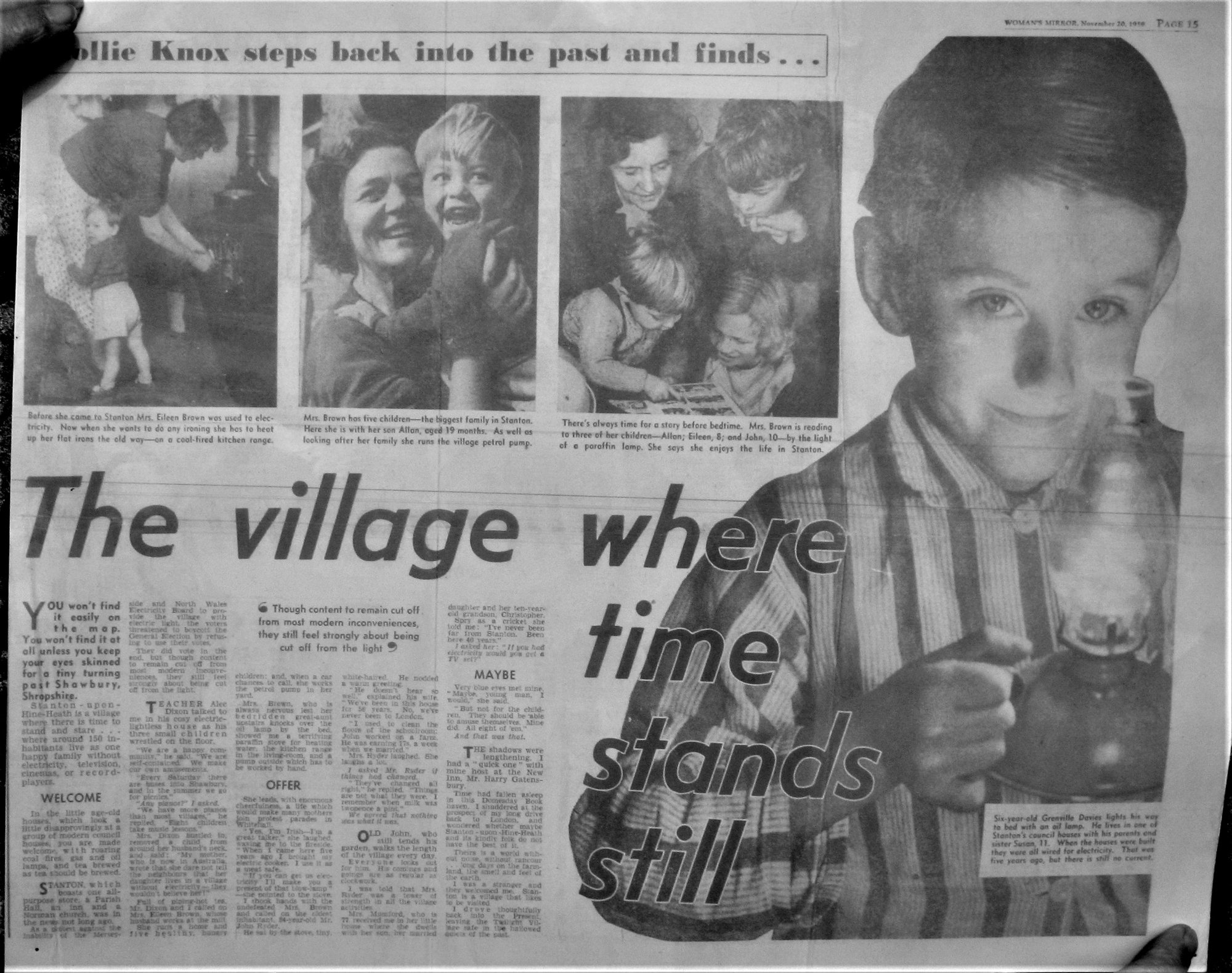
Read text detected in this scan
Automatic transcription may contain errors or an incorrect reading order.
Stanton Parish History Recording Project
Personal Reminiscence File :- PROO9b
Source page 2
A Transcription of the newspaper article
YOU won't find it easily on the map. You won't find it at all unless you keep your eyes skinned on a tiny turning off at Shawbury, Shropshire.
Stanton upon Hine Heath is a village where there is time to stand and stare... there are around 150 inhabitants live as one happy family without electricity, television, cinemas or record-players.
In the little age-old houses which look a little disapprovingly at a group of modern council houses, you are made welcome, with roaring coal fires, gas and oil lamps, and tea brewed as tea should be brewed.
Stanton, which boasts one all-purpose store, a Parish Hall, an inn and a Norman church was in the news not long ago.
As a protest against the inability of the Merseyside and North Wales Electricity Board to provide the village with electric light, the voters threatened to boycott the General Election by refusing to use their votes.
They did vote in the end, but though content to remain cut off from modern conveniences, they still feel strongly about being cut off from the light.
Teacher, Alex Dixon talked to me in his cosy electric-lightless house as his three small children wrestled on the floor.
“We are a happy community.” he said, “we are self-contained. We make our own amusements.”
“Every Saturday there are buses into Shrewsbury and in the summer, we go for picnics”
“Any pianos? I asked.
“We have more pianos than most villages.” He replied. “Eight children take music lessons”
Mrs Dixon hustled in, removed a child from around her husband’s neck and said; “My mother who is now in Australia wrote that she dare not tell the neighbours that her daughter lives in a village without electricity - they wouldn’t believe her!”
Full of piping hot tea, Mr Dixon and I called on Mrs Eileen Brown, whose husband works at the mill.
She runs a home and five healthy, hungry children: and, when a car chances to call, she works the petrol pump in her yard.
Mrs Brown, who is always nervous lest her bedridden great-aunt upstairs should knock over the oil lamp by the bed, showed me a terrifying stove for heating water, the kitchen range in the living-room and a pump outside which has to worked by hand.
She leads, with enormous cheerfulness, a life which would make many mothers join protest parades in Whitehall.
“Yes. I’m Irish - I’m a great talker” she laughed waving me to the fireside. “When I came here five years ago, I brought my electric cooker. I now use it as a meat safe”
“If you can get us electricity, I’ll make you a present of that Blow-lamp” - she pointed to the stove.
Source page 3
I shook hands with the undefeated Mrs Brown and called on the oldest inhabitant, 84-year-old Mr. John Ryder. He sat by the stove, tiny white-haired. He nodded a warm greeting.
“He doesn’t hear so well” explained his wife. “We’ve been in this house for 38 years. No, we’ve never been to London.”
Mrs Ryder laughed. She laughs a lot.
I asked Mr Ryder if things had changed.
“They’ve changed alright” he replied “Things are not what they were. I remember when milk was twopence a pint.”
We agreed that nothing was what it was.
Old John who still tends his garden, walk the length of the village everyday.
Everyone looks out for him. His comings and goings are as regular as clockwork.
I was told that Mrs Ryder was a tower of strength in all th village activities.
Mrs Mumford who is 77 received me in her little home where she dwells with her son, her married daughter and her ten-year-old grandson Christopher.
Spry as a cricket, she told me: “ I’ve never been far from Stanton. Been her 40 years.
I asked her; “If you had electricity would you buy a TV set?”
Very blue eyes met mine. “Maybe young man I would” she said. “But not for the children. They should be able to amuse themselves. Mine did. All eight of them”.
And that was that.
The shadows were lengthening. I had time for “a quick one” with mine host at the New Inn, Mr Harry Gatensbury.
Time had fallen asleep in this Doomesday Book haven. I shuddered at the prospect of my long drive back to London and wondered whether Stanton-Upon-Hine-Hrath and its kindly folk do not have the best of it.
Theirs is a world without noise, without rancour and long days on the farm, the smell and feel of the earth.
I was a stranger, and they welcomed me. Stanton is a village that should visited.
I drove thoughtfully into the Present, leaving the Twilight Village in the hollowed quiet of the past.